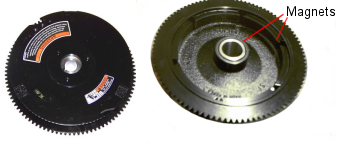
The flywheel on an outboard boat motor serves three general purposes. The first is obviously to provide a way to crank and start the motor. On early-model pull-start applications, the flywheel is used to crank and start the motor, and it also provides a balancing or damping effect on the internal rotating assembly.
Without the flywheel, there would be a tremendous amount of vibration throughout the length of the crankshaft, and those vibrations would be detrimental to the life of the crankshaft bearings.
On newer electric-start outboard motors, the flywheel does more than just help start and balance the engine. The flywheel contains magnets on both the outer and inner diameter. The outer diameter magnets are responsible for generating current as they pass over the stator coils. This is what produces the electrical power used to operate the ignition system and charge the cranking battery.
The inner diameter magnets are used to operate the trigger / timerbase. As the magnets pass over the sensor coils, the trigger or timerbase sends a signal to the power pack / switchbox telling it when to release energy to each specific cylinder. That is where the term “trigger” comes from.
For the flywheel to work efficiently, these magnets must remain in good condition. They need to maintain proper magnetic strength and must be free of cracks or movement from their original position. Some magnets are glued in place, while others are bolted in.
If a magnet becomes dislodged or detached from the flywheel, it can cause serious damage to the stator and/or trigger-timerbase as it spins around while the motor is running.