
Testing an Outboard Ignition Coil
The ignition coil steps up ignition voltage and sends it to the spark plug. A weak or failed coil can cause no spark, hard starting, rough idle, misfire, or a cylinder that drops out under load.
Complete guide: Outboard Ignition Testing Guide
More ignition components to test: Stator Output Tests | Trigger Timerbase Signal Test | Rectifier Voltage Regulator Testing | Power Pack Test Guide | Switch Box Troubleshooting
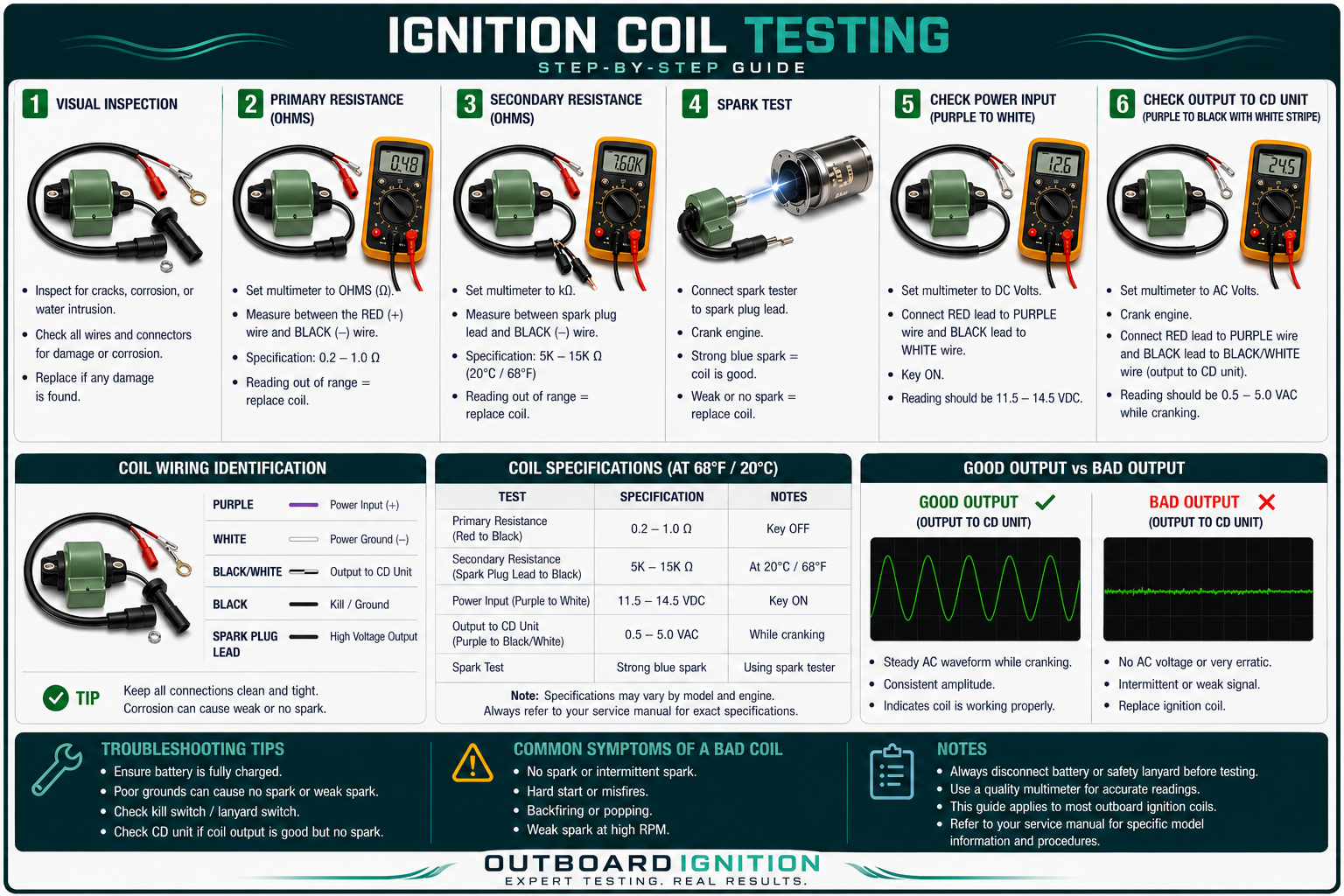
To test an outboard ignition coil, use a multimeter to check the resistance of the primary and secondary windings against manufacturer specifications. In general, primary resistance is very low, often around 0.5 to 5 ohms, while secondary resistance is much higher, often around 5,000 to 10,000 ohms. Exact readings vary by coil design, engine brand, horsepower, and ignition system.
How To: Ignition Coil Testing Overview
Preparation and Tools
Step 1: Locate the Ignition Coil
- Find the spark plug wire: Follow the wire from the spark plug back to the ignition coil.
- Identify the primary wires: These are the smaller wires leading from the CDI box, power pack, switchbox, or ignition module to the coil.
- Inspect the coil body: Look for cracks, swelling, burn marks, melted areas, or carbon tracking.
- Check the mounting point: Make sure the coil is secure and that any required ground path is clean and tight.
Step 2: Test the Primary Winding
- Set the multimeter to low ohms: Use a low resistance range such as 200 or 2000 ohms.
- Disconnect the primary wires: Remove the smaller wires from the coil terminals so the coil can be tested by itself.
- Touch the meter leads together first: Note the meter lead resistance so you do not mistake lead resistance for coil resistance.
- Place the leads on the coil terminals: Put one meter lead on the positive primary terminal and the other on the negative primary terminal.
- Read the resistance: A good primary winding usually shows a low, steady resistance, commonly around 0.5 to 2.5 ohms on many coils.
Very low resistance can be difficult to read accurately. Dirty meter probes, loose contact, or meter lead resistance can affect the reading. Always compare your result to the correct specification for that exact coil.
Step 3: Test the Secondary Winding
- Set the multimeter to high ohms: Use a range such as 20,000 ohms or 20K.
- Place one lead on a primary terminal: Use the positive primary terminal unless the service manual specifies otherwise.
- Place the other lead inside the spark plug wire end: Touch the terminal inside the boot where the spark plug connects.
- Read the resistance: Many good coils read around 5,000 to 10,000 ohms, also shown as 5K to 10K ohms.
- Watch for bad readings: Extremely high resistance, infinite resistance, OL, or no stable reading usually indicates an open or failed secondary winding.
Step 4: Test for a Short to Ground
- Set the meter to continuity or ohms: Either setting can be used to check for an unwanted ground path.
- Place one lead on the metal mounting area: Use the coil laminations, mounting bracket, or metal core if accessible.
- Place the other lead inside the plug wire tip: Touch the terminal where the spark plug connects.
- Look for no continuity: A good coil should normally show no continuity or infinite resistance to ground unless the service manual states otherwise.
- Low resistance means trouble: If the meter shows low resistance to ground where it should not, the coil may be shorted.
Common Symptoms of a Bad Ignition Coil
Interpreting Coil Test Results
Additional Troubleshooting Tips
- Swap coils if possible: If one cylinder has no spark, swap that coil with another cylinder and retest. If the problem follows the coil, the coil is likely bad.
- Check plug wires: A bad plug wire, loose boot, corroded terminal, or damaged resistor cap can mimic a bad coil.
- Test when hot: Some coils pass cold resistance checks but fail after warming up.
- Verify power pack output: If the coil tests good but has no spark, check the power pack, switchbox, trigger, stator, and kill circuit.
- Use a spark tester: A coil can show correct resistance and still produce weak spark under load.
Browse Related Ignition Parts
Use these categories after confirming your engine brand, horsepower, year, serial number, and original part number.
Before You Order
For best fitment help, have your engine brand, horsepower, model year, serial number if available, old coil part number, plug wire style, spark test results, and resistance readings ready.
(918) 457-4099If the coil tests good but the cylinder still has no spark, the problem may be in the power pack, switchbox, trigger, stator, ground circuit, or kill circuit.