Testing an Outboard Stator
The stator generates ignition and charging voltage. A bad stator can cause no spark, weak spark, high-speed ignition failure, or a battery that will not charge.
Complete guide: Outboard Ignition Testing Guide
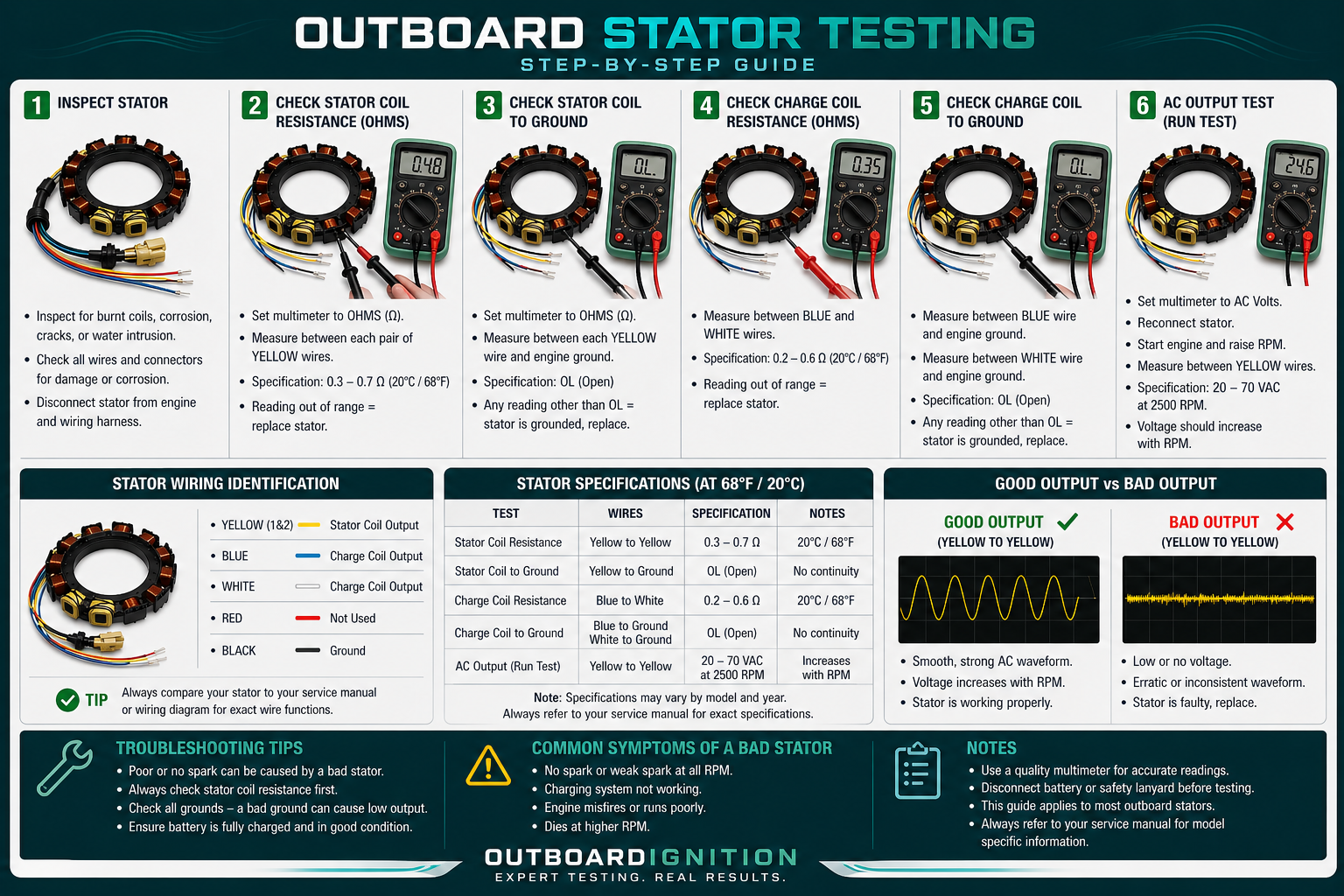
Testing an outboard stator involves using a multimeter to check resistance between wire leads and to check for shorts to engine ground. Charging coil leads, often yellow wires, typically show very low resistance. Ignition coil leads, often red and blue wire pairs on some systems, usually show higher resistance values depending on the model. A DVA adapter gives a more accurate picture of stator output because resistance tests alone cannot always detect weak or broken windings.
Step-by-Step Stator Testing Overview
Preparation Before Testing
Resistance Test: Coil to Coil
- Set your multimeter to ohms: Use the lowest scale that gives a stable reading for low-resistance charging coils.
- Measure charging coil leads: Test between stator output wires such as yellow-to-yellow. Charging coil resistance is commonly very low.
- Measure ignition coil leads: Test the high-speed and low-speed ignition wire pairs, such as red and blue pairs where applicable.
- Compare to specifications: Charging circuits may read as low as 0.25 to 37 ohms depending on system design. Ignition coil circuits may range from about 90 ohms to 1500+ ohms depending on the engine.
- Watch for open circuits: A burnt coil often shows OL, no resistance path, or a reading far outside specification.
Ground Test: Short to Ground
- Place one probe on a stator wire: Test each stator lead individually.
- Place the other probe on clean engine ground: Use bare, unpainted metal for a reliable ground reference.
- Look for OL: The meter should show infinite resistance, OL, or no continuity.
- Continuity means trouble: If any stator lead shows continuity to ground where it should not, the stator is shorted and faulty.
DVA Test: More Accurate Output Testing
A Direct Voltage Adapter, or DVA, is used with a meter to read peak AC voltage output while the engine is cranking or running. This is often more accurate than resistance testing alone because a stator can pass an ohm test and still fail under load, heat, or RPM.
Expected Readings and Tips
Interpreting Results
Browse Related Ignition and Charging Parts
Use these categories after confirming your engine brand, horsepower, year, serial number, and original part number.
Before You Order
For best fitment help, have your engine brand, horsepower, model year, serial number if available, old part number, wire colors, resistance readings, and DVA readings ready.
(918) 457-4099If the stator passes resistance testing but the engine still has no spark, weak spark, or charging problems, DVA testing should be performed before replacing parts.